06.29.09

The great escape to Urbanscapes.

Posted in Events tagged , , , , , , , , , , at 4:42 pm by Celeste

Event: Urbanscapes 2009
Date: June 27, 2009 (Saturday)
Venue: KLPAC, Sentul

What better way to celebrate my 24th by heading over to KLUE’s Urbanscapes last Saturday. It was like one big party for me, and I did not even have to do the planning. Everyone you did not know would just show up anyway. Heh. I could set up a booth saying, ‘It’s my birthday today, come kiss me’, but I did not want to go too far. I bet it’s something you would find at Urbanscapes anyway, though. Heh.

But on to a more serious note, it was my first Urbanscapes experience. And I thought it was quite a nice festival to spend a Saturday at. There was so much going on that I did not know where to start and what to do, that I ended up not really checking out everything at all. Which kind of sucked. Meh.

For those who does not know what an Urbanscapes is, it is a creative arts festival with a very indie theme hanging in the air. There is a marketplace selling very indie fashion clothes. There are performance stages where indie kind of groups go up and do their thing. There is an exhibition hall where all the indie and artsy fartsy, uh, arts are displayed. So, it is quite a niche festival, which is pretty much to my liking.

This year, Urbanscapes had a total of 10 segments going on.

There was a Street Performances area, out in the open under a big tree. Which I thought was a very busking kind of surrounding. It catered to skits and stand up comedies from performing arts institutions, like T4YP, AIIA, EMP, RPT, The ComeBackKings and The Oral Stage.

We checked out some of the stand up comedians, which were just alright. Not like ROTFLMAOwtfbbq kind of funny, but just a ha-ha kind of funny. Which was OK. I was not looking to be blown away anyway.

But the one skit that impressed me was probably AIIA (Artifically Intelligent: Improvholics Anonymous), I think. They had a few people dressed up in costumes – The Joker, Little Red Riding Hood, a mechanic, a sexy secretary, Chun Li, a Japanese dude and a photographer, and they had the crowd shout out scenes of any kind so the actors can improvise freeze motions in 3, 2, 1. The actions they came up with at such a short time were priceless. I liked it.

It was also a showground for busking buskers like KL Stompers and Tugu Drum Circle.

I last saw the Tugu Drum Circle people at Sunburst and once again, there they were, rounding up passers by to provide a tim to the tom, and a bang to the drum.

They drew a much bigger crowd compared to Sunburst. People were voluntarily going up to grab their desired instrument and joining in the improv performance. And I liked that spirit going around in that circle. A pretty good chance for someone to bang their frustrations out.

A crowd grabber was The X Marketplace. As the name suggested, a bunch of indie designer brands came together and brought the crowd wardrobe full of clothes one could go on a spree at.

There were brands by Badgers, Pop! Collective, JouJou & Shugi Toy Art Mart (with designer toys imported from the US), Lah’ Lah’ Land, the Threads Zoo and many many more.

I thought these were cute. Pixelated accessories.

No creative arts festival would be right without a spot for the Lomo lovers.

In fact, you could spot people with lomo cameras and DSLRs walking around and positioning themselves in weird angles, just to take that one creative shot. Makes me feel all demotivated with my “sample” camera. So, forgive me if my shots here are a little out of angle. I was not myself.

There was also a Barsonic booth, blasting the most LapSap music. I thought they were a little out of place, but yet at the same time not so much because when the indie people want to party, Barsonic is where they go to. So, I guess it was alright. But just do not break into a dance in the middle of the day. Or do. Heh.

There were more shopping tents up at the TiC Zone, by the fashion spawn child of Freeform, Tongue in Chic.

Look at the ladies going at it!

At least there were not catfights over a bracelet. Heh.

I did not have the urge to go through the racks and look for something I like. Mainly because I should not. God knows I am not going to stop if I start. Also, I do not like street markets under the hot sun. First half of Urbanscapes was sweltering like a pig.

There was also the Makan Boulevard, because no one in their right mind would organise a 12 hour festival without food. Or maybe there is, but I do not want to name names.

Plenty of food to go around. Hotdogs from Palate Palette, kebabs, rice sets, ice blended bubble teas (which was always trailed with a long queue), loklok and much more.

For music lovers, there was The X Lawn. The line up was not bad as well, with usual suspects like 40 Winks, Yuna, Pesawat, Gerhanda Ska Cinta, Pure Vibracion and Killeur Calculateur.

I only managed to catch 40 Winks and they were quite alright. Very reggae and big band-ish with their brass going on. I liked it that at the front of the stage the fans were not moshing, but dancing – reggae style thingamajig – along to the music. Ah, where is the love, you ask? Here it is. Heh. (Corny, I know – it comes with the age, unfortunately).

Exhibition is where the artsy farts would go.

You can even tapau-a-monster there. It was so darn cute! I almost wanna tapau one home. But I had to restrain myself from the doggypack. I havebought enough of these self-sewn soft toys in weird fabrics and designs that now they are all sitting in a box neatly stacked in the upside cupboard in Penang. So, I should NOT tapau another monster home. Heh.

But still, it would be nice to get myself a little souvenir to commemorate Urbanscapes. What can I say, I am a sap. I would have bought an official Urbanscapes T-shirt but they ran out of my size. Boo. So, I guess it is OK to buy myself a little handmade badge by Oh & Ah. Cuties, aren’t they?

KARYA stuck a few colourful blocks in between wires, and voila, a metaphoric metropolis.

There were even little fish ponds made out of newspaper and basins.

Other segments at Urbanscapes were Indicine, the Cinescape Stage, The Box and the Sunset Disco.

However, it was a shame I did not take enough time to check out everything. So much was happening at the same time, I forgot my to-do list. I did wanted to go see Sepet at The Cinescape Stage, but of course that escaped my mind. Also, I had to leave early too because I needed a ride back. So, I had to miss out on Twilight ActionGirl at the Sunset Disco, and some fire twirling action going on after sundown.

But all in all, it was a fun day out with friends. Bumped into some people I know and met a few new friends on the way – hi, Reta. Even the staffs were generally nice folks. There were no shoving or pushing around; a very nice place to chill out indeed. Maybe next year I will stay on the full 12-hour. Well done, KLUE. It was an awesome birthday party festival. Heh.

ETA: Words have been going around on Twitter that someone who was infected with H1N1 was at Urbanscapes that day. Read KLUE’s official announcement regarding the incident here. If you are feeling unwell, or you are worried you might be infected, do go for a checkup. Be safe, kids.

06.24.09

Book review: Famous Street Food of Penang

Posted in Reviews tagged , , , , , , , , , at 12:39 pm by Celeste

Also guest blogging at Backseat Radio: Doing pilates and Keane live in Singapore @ 13 August 2009.

—–

“Discerning foodies invariably dismiss Penang delicacies sold outside of the island as pale imitations of the real thing. Penangites in Kuala Lumpur are usually prejudiced against the Penang hawker food available in the city – they tend to claim that the snacks or noodles are not 100% “authentic”. Even if the food vendor is a member of a Penang family that has made a name for itself with a specific regional specialty. Penangites tasting the food will still insist that it just isn’t the same.”
- p. 8-9

*Takes a deep breath* Hokkien mee, Curry mee, Loh mee, Tok tok mee, Lam mee, Jawa mee, Mee goreng, Nasi kandar, Char kuey teow, Char kuey kak, Lorbak, Oh chien, Or kuih, Chai kuih, Ban chang kuih, Chee cheong fun, Ais kacang, Bubur kacang, Rojak!

Phew, what a mouthful!

And what a mouthful indeed, when you venture up north of Malaysia to Penang for their endless variety of hawkers food.

For a Penangite, some time in your life while growing up, you are bound to hear tidings of who sells the best what in which street. Although you may not have been there and try it yourself, you know they are there, firing up their stoves in the wee hours of the morning to serve a long line of customers for the day.

For people born and bred elsewhere, it may be a little hard unless you engage with a local Penangite and trust him/her to bring you to the best vendors around the island.

However, if you do not have any friends or relatives hailing from Penang, why not pick up a copy of Famous Street Food of Penang: a Guide & Cook Book compiled by The Star Publications.

Inside, it has everything you need to know about filling the tummy in the Pearl of the Orient. From catchy stories of the vendors themselves, whom most of them took over their parents or grandparents business and are still doing the works for at least a decade, to concise locations of their stalls on the island, to even recipes on how you can cook up your own char kuey teow and ban chang kuih!

The Star Publications is one of the more sought after newspapers available in Malaysia, so you can definitely trust them to be straightforward with their writing, while at the same time, engaging.

I like it that they are clear and concise about the history of Penang in the introduction, unlike a certain book I reviewed a while that seemed to go on and on and on.

As the saying goes, everyone has a story to tell, and the hardy people of The Star managed to dig deep and get the story. This shows that they are not merely collecting information from all over and slapping them into a compilation; they really do go out there and get things done.

As I was going through this book, I thought to myself, if I were to come up with a collection of stories or a coffee table book, it would be something along the line that The Star is walking on. The kind of stories that are not displayed out to the public for everyone to read. The kind that you need to grab a hold of the storytellers, sit them down for a cuppa (and perhaps buy them the cuppa), and probe them to tell you everything as if you were their confidante.

The recipe at the back of each story/dish is also something fun for the readers. With precise steps of how to prepare every dish mentioned in the book, who knows, you could be the next Hokkien Mee vendor stealing the scene in Sarawak or in the heart of KL!

Also, it is quite a good book to bring along with you if you are staying overseas, and will not be returning home for a long while. Having the recipes to whip up a meal of nasi kandar in your very own kitchen over in Melbourne or England is enough to satisfy your craving for the time being. Hey, beggars cannot be choosers; anything is better than nothing.

Alas, there is only so much you can include in a book. Where is the duck-lapped Kuey chiap, or the gooey substance sprinkled with finely grinded peanuts – Muar chee, or the pork-crazed Bak kut teh, or the colourful array of Kow chan kuih?

But seeing that The Star has covered most of the hawkers food already, I guess it is OK to let them off the hook for this one. After all, they succeeded in making me miss the food back home. (Why, yes, I am quite the family’s daughter, missing food over my family; but believe you me, most of us Penangites are like that, heh)

However, whether all Penangites would agree that all the vendors mentioned in the book is the best, is another matter. Some may argue that the Kayu nasi kandar is not the best but the Line Clear nasi kandar across the Penang Road; while others may prefer the charcoal cooked Curry Mee available in the Air Itam street market (featured in the front cover of the book) tops the gas cooked one at Lorong Seratus Tahun.

Each to his own, really. The only way to settle your score is to head on up to Penang and go on a big binge out yourself.

Now, who’s with me on a foodie road trip to Penang?

06.15.09

Sunday’s Marmalade matinee.

Posted in Food tagged , , , , , , , , at 3:19 pm by Celeste

Also guest blogging at Backseat Radio: Aimee Mann live in Singapore @ 29 August 2009.

—–

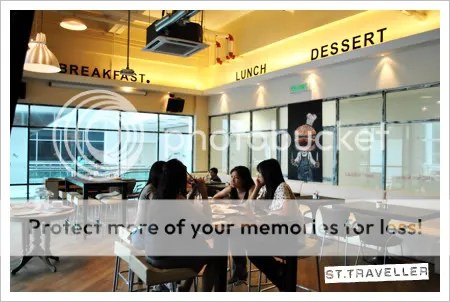
It was another Sunday of nothingness, as I lay in bed trying to decide where to go for a quiet meal for one, when I recalled a sweet little place at the corner in Bangsar Village II, where Leng and I last met up for some afternoon tea a while back. It was also a day to try out new joints and see if I like it, instead of heading for another round of waffles at Deli.cious Cafe.

The place was already rowdy with expats and locals with friends, families and kids. Children were running around the wooden floor, as parents engaged in conversations with one another and read the day’s newspapers while sipping on coffee getting cold, cross-legged.

It was already well past noon when I arrived and the breakfast menu has ended. When at a new place and wary as to what to order, delve for the Chef’s Recommendation. You have half a chance of getting it wrong. So, I ordered a Smoked Salmon Quiche, a baked slice of battered smoked salmon, eggs, peas and whatnot, and a glass of Day Starter, a fruit juice consisting of apples, bananas and strawberries blend.

I stole the cherry tomatoes from the cute salad bowl, and delved into my quiche as I continued on a few more pages of Keruoac’s On The Road.

The quiche was just right: it was not too heavy, the eggs were fluffy on the tongue, and the salmon added a sweet tinge in every bite. I was about to finish it when I wondered if I would ever get filled with this slice, then the tummy took up the stop sign and I was suddenly filled.

The Day Starter was refreshing. Every gulpful was a different taste, sometimes apple, sometimes banana, sometimes strawberries. I could still sip the seedy texture of the strawberries. It was nice and thirst-quenching.

I like it that they have cutesy designs on the wall, and they do not go overboard with it. Even their counter and the cakes they serve are a real eye-catcher too. It definitely gives out an atmosphere where you would see yourself in a sundress, sipping iced tea and enjoying your favourite book.

I also managed to catch some familiar tunes playing in the background. Songs like The Boy Least Likely To’s Be Gentle with Me, The Feeling’s Fill My Little World and The Moldy Peaches’ Anyone Else But You. You know, those adorable and indie ones.

Granted it was first built a family-oriented cafe, so if you cannot stand kids running around and screaming, you may want to avoid the place, especially during weekends. But if you are not too picky, and you like doing funny faces to the babies in trolleys when their moms are not watching, may we suggest our next Sunday matinee at Marmalade?

++
Marmalade Cafe

1F-18, 1st Floor
Bangsar Village II
Jalan Telawi 2
Bangsar Baru
59100 Kuala Lumpur
Malaysia
Opens 10AM-10PM
T: +6 03 2282 8301
E: contact@ilovemarmalade.com.my
W: http://www.ilovemarmalade.com.my

06.08.09

Remember, remember, the 11th of November.

Posted in Destination tagged , , , , , , , , , , at 2:45 pm by Celeste

Also guest blogging at Backseat Radio: So, who’s gonna watch you die?

—–

We had just landed in Labuan on the first day, and I was still sulky over the jetlag when the van stopped in front of the WWII Memorial along Jalan Tanjung Batu. Inside the cemetery the air was still. The tooting motorcycles and zooming cars that pass by indifferently sounded so distant in the vicinity, like there was an invisible bubble keeping the noises out from the yard so the weary ones could sleep another eternity.

Surrounding me were 3,908 soldiers in perfectly squared platoons, much like how they would stand in salutation when they were alive. The Cross of Sacrifice gravitating them around it like the sun holding the solar system together. These soldiers were from all over: Australia, Great Britain, India, New Zealand and even Malaysia.

The island of Labuan, strategically located in the South China Sea and bloated with oil supplies, quickly became a must-have location to the Japanese during World War II. With immediate effect, the Imperial Japanese Army set out to conquer the island, obtaining it on January 1, 1942.

During the Japanese ruling, a POW camp (Prisoner-of-War camp) in Sandakan, Sabah, some 2,500 captives made up of Indonesian civilians and Australian and British war prisoners shipped in from Java, Indonesia, were forced to construct an airstrip at gunpoint. They were often beaten out of spite and left with little food and medical treatment.


When the Allied Forces advanced in 1945, the Japanese Army were forced to flee. Thus, began the Sandakan Death March. The remaining 1,900 prisoners were moved – in sickness or in health – towards the mountains of Ranau some 260KM from the Sandakan POW camp. 300 who were in bad health were left behind in the camp to perish, while the others either died on the way because of starvation and serious illness, or shot dead for slowing down the March.

The Dead Marches occurred from January to June 1945, the population of each March getting lesser and lesser. By the time they reached Ranau, less than 40 POWs survived, all of which were too weak to work for the Japanese Army and were shot dead anyway. Out of the 2,500 POWs, only six managed to escape the iron fist of the Imperial Army. They were helped by local people, who fed them, nursed them and hid then from the Japanese Army, before eventually being saved by the Allied Forces.

On June 10, 1945, Operation Oboe Six commenced with amphibious landings of the Australian 9th Division. Their objectives were to secure the Brunei Bay for the Allied naval base, and to re-capture the oilfields and rubber plantations from the enemies. A fierce battle began in a swampy area in the jungle known by the Australians as ‘The Pocket’, where the Japanese ambushed the Australian army. The fight went on till the end of World War II on August 15, 1945. 114 of the Australian 9th Division perished, while more than half of the supposed 2,000-strong Japanese Imperial Army died in battle.


Today, the POWs of Sandakan, the perished war heroes of the Australian 7th and 9th Divisions, as well as those of the Punjab Signal Corp and a few locals were all buried here today at the WWII Memorial in Labuan. Most of the bodies were shipped in from Sabah, some with their military tags still glimmering around their mangled necks.

They were all given a white headstone each with their names, military positions and death ages engraved on it. Poignant messages from their family members still resonate today with heavy heartaches that would dwell tears in the eyes. Of the 3,908, 2,000 of them were unidentified, and they were merely given a similar engrave of ‘Known unto God’ – while their bravery may not be known of on earth, it is not forgotten in the eyes of God.

When I strolled through the Memorial, my heart twisted at the messages their family members wrote for the fallen. While some seemed to have made peace of their loss, others seemed to be holding onto a grudge that echoed in every engraved letter on the tombstone: Sgt Isherwood: “In this foreign grave his body was lain, He died for us but was it in vain”; Driver Cheesman: “Memories are treasures none can steal, deaths are heartaches none can heal”; Cpl Lavender: “Thinking of you over there, far away, wondering why it must be”.

When I came upon Gunner Wicks’ tombstone, it got to me. The epitaph his wife wrote, I did not know why, but it got to me. Somehow, the thought of a foreigner fighting for the love of a land that was not even his, seemed as heroic and heartbreaking as ever. And especially the ones who were unknown. They gave their lives for a foreign land, but yet they could not be remembered on their own tombstones. Just like that, their heroic names ceased to exist forever in this earth.

But these are all decades ago. Like another lifetime. As I knelt down in front of a stranger’s grave, I paid a silent moment to the 3,908-strong bravery around me, taking in the comfort that at least the loved ones who had wept at their graves and written such gripping epitaphs are with them now. Nothing is lost.

On the first Sunday of November every year is Remembrance Day, or ‘Poppy Day’. War veterans from Australia as well as locals and visitors from all over would gather in the WWII Memorial to pay tribute to the brave souls of yesteryear.

They would wear a red poppy on their chest, a universal symbol for Remembrance Day that is in reference to the famous poem written during World War I, In Flanders Field, where the red poppies grow abundantly, and where war casualties were buried in France. It was written by a Lieutenant Colonel named John McCrae in 1915, after witnessing the death of his 22-year-old friend during war.

In Flanders fields the poppies blow
Between the crosses, row on row,
That mark our place; and in the sky
The larks, still bravely singing, fly
Scarce heard amid the guns below.

We are the dead. Short days ago
We lived, felt dawn, saw sunset glow,
Loved, and were loved, and now we lie
In Flanders fields.

Take up our quarrel with the foe:
To you from failing hands we throw
The torch; be yours to hold it high.
If ye break faith with us who die
We shall not sleep, though poppies grow
In Flanders fields.
- Lt-Col John McCrae (1872 – 1918)

Make peace, not war.

05.29.09

Eating Labuan.

Posted in Food tagged , , , , , , , at 4:09 pm by Celeste

When it comes to Labuan, I regret to admit that I do not know much about the island that is half the size of my hometown. All I know is that it is a place where people only go for business regarding the oil and gas industry. Oh, and of course, some duty free shopping.

However, my better judgment told me that there has got to be more to Labuan than money and cheap vices. So, I decided to get to the bottom of things, ask around the locals on where and how to experience some good ol’ Labuan cuisine.

So, we decided to spend a day at the Labuan Weekend Market, perpendicular to Jalan OKK Awang Besar and Jalan Perkhidmatan. And it was here I found all I need to know of Labuan’s local delicacies.

There was a row of stalls selling almost the same kinds of kuih-muihs at the market. They were as cheap as RM1 a pop. We found a stall selling the most variety of cakes and pastries, paid for our food, which were probably nothing over RM10 in total, and sat down to enjoy them.

Lamban is like little fingers of goodies. Although they may be small, they are still able to fill up your tummy. Made from the pulut rice, lamban tastes like the Malay’s ketupat or the Chinese’s rice dumplings. This was probably the most favourite out of the ones I tried, and I was kind of sad when there were no more left when I finished all four little sticks.

Firstly, the rice is steamed before wrapping into little cylinder forms of coconut leaves, and then put through the steaming for another time. The sweet lamban is eaten with a dip in the peanut sauce that creates a small spicy kick for the taste palettes.


Another common local food in Labuan is the Punjung. Made from rice flour, they are little cone-sized desserts with green jelly-like fillings wrapped in banana leaves. At first bite, it felt pretty much like the kow chang kou (multilayer pudding) I used to eat when I was younger, whereby I would peel off layers by layers and eat them slowly.

The making process may be simple – I mean, what could be harder than making the batter and filling them into the coned banana leaves? – but it is not. Apparently, the batter has to be of the right texture; if it were too soft, it will just drool out of the leaf before hardening.

Wrapped in lined nipah leaves are bundles of sin in the littlest forms – Jelurut. A delicacy derived from Brunei – known there instead as selurut or celurut, it is made from rice flour, sugar, coconut milk and other basic ingredients. Jelurut is the fattiest and sweetest local food of all the Labuan dessert spread. I did not really enjoy this one, though. Got jelak for me after a while.

A tourist, like me, would be ignorant and just peel the leaf off the filling and sink my teeth into the jelly texture. It is only later when I found out that the right and more fun way to eat jelurut is to twist the flat bottom to squeeze out the food. Jelurut is usually green in colour, but has picked up other kinds of flavours through time, such as durian and yam.

Tapai is quite a common delicacy found even in the Peninsular Malaysia. It is alcoholic dessert made from pulut rice, water and ragi, a fermented ingredient that is the most important in making tapai.

Because of the ragi, tapai has an alcoholic taste to it. Rice plus liquer: not really my cup of tea. Or, plate of rice.

The making procedure is fairly simple, but tapai is one of the local delicacies available that has the most superstitions revolving around it. Apparently, tapais can only be made by individuals, instead of groups, and it is best made in the middle of the night, when everyone is asleep, and the maker has a lesser chance of being disturbed.

Even a question as simple as “ah, you’re making tapai?” could ruin the outcome of the dessert! Ancestors believed that when you speak, spits of your saliva might end up in the mixture, which might make the dessert go sour.

Also, tapai makers have to be in the ‘purest’ form before attempting to make the dessert. Women having ‘that time of the month’ are not allowed to make tapai, in fear that the food would turn out red! And one must ‘cleanse’ oneself before making the food, such as taking a thorough shower or something as simple as cleaning your hands with soap.

There are also other titbits you can find in Labuan, such as the sweeties like Telapam and Wajik, and the spicy Pulut Panggang and Pais Udang. You can probably find these food scattered throughout the island, but if you are a little clueless as to where to head to, just stop by the Weekend Market.

05.21.09

Book review: Three Cups of Tea

Posted in Reviews tagged , , , , , , , , at 1:34 pm by Celeste

‘Three Cups of Tea’ by Greg Mortenson
and David Oliver Relin @ Amazon.com

“If you insist on keeping your kafir school, you must pay a price,” Mehdi said. the lids of his eyes lowering. “I demand twelve of your largest rams.”

“As you wish,” Haji Ali said, turning his back on Mehdi, to emphasize how he had degraded himself by demanding a bribe. “Bring the chogo rabak!” he ordered.

You have to understand, in these villages, a ram is like a firstborn child, prize cow and family pet all rolled into one,” Mortenson explains. “The most sacred duty of each family’s oldest boy was to care for their rams, and they were devastated.”

… All the boys wept as they handed over their most cherished possessions to their nurmadhar. Haji Ali led the line of rams, lowing mournfully, to Haji Mehdi, and threw the lead to him without a word. Then he turned on his heel and herded his people toward the site of the school.

… “Don’t be sad,” he told the shattered crowd. “Long after all those rams are dead and eaten this school will still stand. Haji Mehdi has food today. Now our children have education forever.” – p.152, 153

This is why Mitch Albom does not work for me: I read Tuesdays with Morrie, and I was not impressed at all. Some could get all emotional with the advices given, but all I saw was an old man with a lot to say before he dies. And mostly they are advices you probably would have figured out by yourself the more you put yourself out there in the world anyway.

There was no character growth, no suspense, no conflict, no climax. Just. One spoiled young man getting bitch slap verbally to his senses. You just wonder if Albom is writing self-help books, or just writing self-indulging books.

Three Cups of Tea may not have been as interesting if Greg Mortenson has not lived it. Merged together with David Oliver Relin’s appropriate writing style, it was published with enough dosage of descriptions on the destination, as well as the Muslim culture there, and also punchy facts that could grab you heart with one single sentence. He does not overdo his writing to grab anyone’s attention, because he knows that the story he is writing will already be good enough to do all the captivation.

The excerpt above is one of the more touching parts of the book. It showcased a wise old man, Haji Ali, who went faced with a thread or any problems life throws at him, would remain calm and let things unfold naturally in the name of Allah.

Heck, he even gave Mortenson a whopping when he was pushing against time on the people to build the school in Korphe, and also gave him a good scolding when he wandered into Waziristan without asking for help.

Another favourite character of mine would have to be Jean Hoerni, a former climber who hit the jackpot when he created a computer chip that is used widely till today in the Silicon Valley. It was funny the first time they spoke on the phone:

“I know what you’re after,” a sharp voice with a French accent interrupted. “Tell me, if I give you fund for your school, you’re not going to piss off to some beach somewhere in Mexico, smoke dope, and screw your girlfriend, are you?”

“I…” Mortenson said.

“What do you say?”

“No sir, of course not…”

And.

“So. What, exactly, will your school cost?” Hoerni barked. Mortenson fed more quarters into the phone.

“I met with an architect and a contractor in Skardu, and priced out all the materials,” Mortenson said. “I want it to have five rooms, four for classes, and one common room for-”

“A number!” Hoerni snapped.

“Twelve thousand dollars,” Mortenson said nervously, “but whatever you’d like to contribute toward-”

“Is that all?” Hoerni asked, incredulous. “You’re not bullshitting? You can really build your school for twelve grand?” – p.55

Beats an old man sitting on his death bed giving mere lectures any day, don’t you think?

There will always be a reason out there for us for doing charities. We can tell ourselves that we don’t have the money of famous celebrities or millionaires, and that we are not capable of supporting even ourselves to help the less fortunates.

But here is Mortenson, who set up home in a self-storage box and sleep at the back of his car, eat $0.99 donuts for breakfasts and have $3.99 croissants and coffee for dinner, all because he want t o save a little more for his journeys back to Pakistan. And nobody else would offer donation because he was not a climber who scaled K2, but one who failed to.

Here is a poor helping an equally poor; what do you have to say for yourself now?

When you are reading Three Cups of Tea, don’t expect to be pulled into travelling there with Relin’s descriptions of the flowing Indus River, or the hustle and bustle of the Rajah Bazaar, or the innocence of Korphe Valley, or even the spectacle that is K2. Relin provided the dark side of this land, as blunt as it is supposed to be over there.

But Relin still managed to capture the readers with enough amount of descriptions merged with straightforward facts. I was grabbed instantly at the first chapter, titled ‘Failure’. Not only did Relin mentioned about Mortenson failing, he also talked about the many mountaineers who not only failed, but died, on the way down from K2 years before Mortenson’s attempt. Which shows that Relin did his homework when putting together this book.

The description on the Art Gilkey Memorial caught my attention specifically:

For two days, Mortenson and Darsney drifted in and out of the facsimile of sleep that high altitude inflicts on even those most exhausted. As the wind probed at their tents, it was accompanied by the sound of metal cook kit plates, engraved with the names of the forty-eight mountaineers who’d lost their lives to the Savage Mountain, clanging eerily on the Art Gilkey Memorial, named for a climber who died during a 1953 American expedition… But the number of metal plates chiming in the wind would multiply, as four of the sixteen climbers who summited that season died during their descent. – p.15

I look at the world today, and often question what has happened to us. A pregnant woman killed because another man’s greed for money to indulge his date. Families killed because of jealousy and desperation of another. Even in your everyday lives, drivers cannot even do the easiest decency of giving way on the road. It just makes me wonder if there is still any good left in this world.

But when I read Three  Cups of Tea, it moved me that somewhere out there, there is a man in a foreign country, doing his bit to make the world a better place. Out there somewhere, there is a community of people, who would still extend their helping hand and into their very own homes when you were lost and in need of hospitality. People, who has no idea who you are, would just volunteer to help you out in whatever you want to do without any prejudice. For a while, as long as you keep the pages turning, the world seems alright.

++
For more information, stop by http://www.threecupsoftea.com and http://www.penniesforpeace.org.

05.12.09

Miri International Jazz Festival : Day two

Posted in Events tagged , , , , , , , , , at 11:04 am by Celeste

Event: Miri International Jazz Festival 2009
Venue: The Pavilion, ParkCity Everly Hotel
Date: May 9, 2009 (Saturday)

Being in my second jazz festival, I still find it hard to get used to seeing the media having normal conversations at the table with the musicians. I was always under the impression that musicians are a kind of celebrities that are unreachable. You know, the type that will only talk to you during press conferences and only when you ask questions that they like to answer.

So, it was nice to have breakfast with Mia Palencia, or lunch with Raphael Geronimo, or drinks with Pascal Seixas, exchanging pleasantries and making conversations and laughing at bad jokes.

At the ParkCity Everly Hotel’s restaurant, we were not media people nor musicians. We were just normal people, who happened to be at the same place and at the same time, sharing the same interest in music.

Friendships were formed too amongst the musicians. There was even a friendly football match between the Frenchmen and Australians that afternoon, and surprisingly enough, the Aussies won 3-1. Heh. Made you look at the French team in a whole new light, does it not?

That night, Dites 34 picked up where Alamode left off the previous night with their jazz rendition of traditional French folk music. Instilled in their songs were the typical kind of cheekiness I grew to love in Yann Tiersen’s songs.

Overheard @ MIJF: “Some girl came up and asked where’s that French guy with the typewriter.”

Although most of them were few with words, the members were quite amazing onstage. The rigid force of Quentin Biardeau’s alto sax and the languid flow of Guy Giuliano’s accordion harmonised well to the kind of folk French style that is lovable. Sebastien Janjou’s easygoing guitar licks and Adrien Chennebault’s quirky percussion, together with Pascal Seixas’ witty double bass contributed their part in the world music-ish sound of Dites 34 that made them stand out the way they did at MIJF.

As Giuliano had performed with Alamode the night before, likewise Spaccavento offered a part with the Frenchmen with his own saxophone jams.

Jeff Maluleke was this single entity sitting at the corner of the press conference room the day before, but he won the hearts of many media personnel instantly when, due to his lack of English, started singing in his own language. His voice was an orchestra by itself.

His band kicked off their set with the conventional kind of African Jazz/Reggae with the calming thuds of the congas. It was soothing and soulful, and halfway through the set, I thought to myself, “man, wouldn’t it be nice to have a joint right now”. Heh.

However, to me, his voice seemed to have been robbed of by his band. I thought he would have pulled off quit a show if he had just done his performance singing and beatboxing all by himself.

By the second half of his set, the Pavilion had filled up immensely as Maluleke delved into a more upbeat tempo. People were dancing and clapping along, singing in unison to the encore of ah-oh-ah-eh-ah-oh.

Up onstage, Maluleke was dancing around to his own music, enjoying the night as much as the audience was. Like it was his own full blown concert. By the time he was done, the crowd was cheering and whistling; it was probably the loudest encore at this year’s MIJF.

I took a little toilet break during the intermission. The out-of-order sign made me steered my way to the second floor, only to find Seixas  checking out the two sape players playing by the stairway. When I got out of the washroom, he was already sitting down with a sape in his arms, eager to get the tune and technicality right.

This was what comforted me: musicians being so passionate about their music they just want to create music with any instruments they can find, even though it is an instrument they are unfamiliar with.

To me, a true musician does not need an essay to explain what music is to them; just look in his eyes the way he falls in love with a new instrument, and how meticulously he would like to learn it. It speaks more than the thousands of words I can never begin to describe.

Overheard @ MIJF: “Raphael!!!! I love you!!!

When I first met Raphael Geronimo, he was all alone in the restaurant for a late lunch in the next table from mine, and I thought it was kind of cute when he said ‘terima kasih‘ to the waitress. I thought he was just a patron of MIJF until he mentioned that he was a performer.

Geronimo seemed pretty much a normal fellow offstage. His kind soul took him around for conversations with many people, and when bored at his own conference, he would doodle sketches on notepads discreetly. But when he was all dressed up and had tuned his timbales for the band’s set, he was very much a different person.

Overheard @ MIJF: “You know that conga player – from Rumba Calzada. Don’t you think he looks like, well – Mr Potato?”

Rumba Calzada was back for their second year at MIJF, after being voted most favourite band in 2008. They were even a nominee for the Juno Music Awards in Canada; that is saying something about the band, right?

Their salsa beats brought to the plate something different from the other bands featured at MIJF this year. Whether they were fast in tempo or slow in rhythm, everyone was dancing. Heck, even us media were going at it backstage until the organisers told us off. Heh. It could have been the tequila doing its works, but while they were up onstage, even the most prepped and uptight people in the room seemed to have let down their hair and ties and just went with it.

It was amazing.

This year, MIJF ended with a band – literally – with the 17-piece powerhouse from Singapore: Thomson Big Band.

Overheard @ MIJF: “No wonder the flight is full; the Thomson Big Band is with us!”

Saxophonists, trumpeters, percussionists and such crammed into the small stage and performed jazzy tunes that reminded you pretty much everything New York City is all about. They were probably the only band hitting straight for jazz.

It was grand and it was glamorous, and they got the crowd swaying to their sensual sax solos, and snapping their fingers to the ch-chi-cha-ch-chi-cha’s of the percussion’s crash cymbals.

Overheard @ MIJF: “I bet they met up in the toilet earlier and came up with the jams with eye signals, and decided ‘hey, let’s not tell the audience and see them freak out.’”

A jazz festival would not be complete without a great jamming session with all the performers. Judging from the size of the bands for MIJF this year, it was a mighty mighty session indeed.

Neptune whipped out his shakuhachi, while Spaccavento his saxophone and Giuliano his accordion and Geronimo his timbales, Palencia and Maluleke their wonderful vocals… And when Bombay Baja went up onstage, it was bonkers.

Bombay Baja exited the same way they entered the night before for their set, leading a trail of audience behind them, as if to a wedding procession down the road. Now, this is how they should be performing. Not onstage blaring their horns at the audience while jumping around awkwardly, but at the lawn with the crowd surrounding them and dancing to their music. It was then they seemed more appealing than last night.

Overheard @ MIJF:“Jazz is the common language for people from different parts of the world, speaking in different tongues and living in different cultures.”

I had an awesome time there. Not only were the music good, the people were good too. Media, musicians and organisers included. It was like one big family, and I was glad I was a part of it with such interesting people.

The following morning, we all boarded the same plane with heavy hearts back to KL, while some would hop on the next planes back to their own countries. For a weekend, the world outside of Miri did not seem to matter – did not seem to exist – until that moment when we parted. Reality calls, alas. But I guess, that is what makes the memories fonder, no?

05.11.09

Miri International Jazz Festival 2009 : Day one

Posted in Events tagged , , , , , , , , , at 3:12 pm by Celeste

Event: Miri International Jazz Festival 2009
Venue: The Pavilion, ParkCity Everly Hotel
Date: May 8, 2009 (Friday)

The sun beamed at a 5 o’clock hue that is warm and tender. Outside my balcony, the South China Sea lapped languidly against the shores of Miri, and downstairs at the ParkCity Everly Hotel lawn, tents were set up ready to welcome the many guests for the Miri International Jazz Festival that night.

While smoking a cigarette outside, a saxophonist practised his scores and notes a few rooms down. Despite the tiresome jet sets to the Borneo island and back again for the past couple of weeks, the musician’s precise slurs echoing in the premises assured me that this would be quite a weekend.

This year’s MIJF took off nice and easy with Malaysia’s own Double Take. With the vocal powerhouse of Mia Palencia and the complementing guitar licks of Roger Wang, it was as simple as it can get.

Overheard @ MIJF: “Roger looks like some ah pek out on the street, you’ll never know that when he performs he’s this musical genius!”

Palencia’s strong and deep voice is the kind that reminds you of a good time during Christmas. You know, fireplace, hot cocoa, chestnuts roasting on an open fire kind of works.

Their performance suited the MIJF early Friday crowd well. With only less than 1,000 then, Palencia’s aggressive voice bounced off the audience’s heads and rose up to the high-ceilinged venue with a bunch of covers: Somewhere Over the Rainbow, jazzed up versions of Michael Jackson’s Billie Jean and Man in the Mirror for the encore, and Sting’s If You Love Someone, Set Them Free.

However, despite all that Double Take has, I was not really grabbed just yet. They have the kind of style a lot of Malaysian bands would like to go for, and I was hoping for something different. Nonetheless, they did put on a great show and it felt like a great start to a perfect festival. But in the sense of being blown away, I was far from it.

Overheard @ MIJF: “Here’s my key card. Oh, and bring your turban. *growls*”

Now, when I first heard of the Bombay Baja Brass Band, I was pretty much intrigued. Out of the nine members, seven of them were Brits, and they were going around in Punjabi suits and turbans. Heh. They were quite a fresh breath of air.

But, after hearing them twice before their performance – once at the MIJF welcoming dinner and another during their soundcheck of sorts out in the Everly premises – they kind of became boring for me after a while. I mean, how differently can you get with the kind of rhythm the dhol can offer? 30 minutes into their set, it felt like they have gone on for two hours.

Yet the crowd seems to like them. The band got the crowd to do the Bhangra dance of “screwing the lightbulb” while “patting the dog” at the same time. They had good showmanship, I would give them that. Like I said, it was a fresh breath of air, but like all oxygen in a new part of the world, it smells the same after a while.

And, it was around this time we found out that Everly serves pretty awesome mojitos at RM12. Heh.

When you listen to John Kaizan Neptune talk, you know he is passionate about his music. So passionate that he seems a little, well, off. He tends to go on and on about his view, and he always seems to be gazing a little off to the distance from the present world he is in.

When he started talking about the technicalities of his music instruments, half of the crowd did not really care and was chattering away. But when he started playing on his shakuhachi, a Japanese bamboo flute known to be used for zen meditations, the people were snapped into his trance, just like that. This is the time when we were able to share his often distant looks and off-ness.

He performed with Steps in Time, a multi-cultural ensemble of Indian drumming and strings, jazzy guitar glides, funky wild bass and a rocky steady percussion. It was a performance with a base of Japanese traditional music fused with Indian beats. The violin came out like the Chinese er hu, and together with the Japanese flute, it was like a perfect duet of two lovers. At the background, the timid manjira and bopping ghatam fills the air, welcoming you to feel the romance.

It was sensual. It was comforting. Close your eyes, and you would be transported to a world of falling sakuras in Kyoto and the shibuya centre of Tokyo. Perhaps there is where John Kaizan’s mind is.

Overheard @ MIJF: “They keep on turning their backs on me, I get to check out their asses.”

Since leaving Australia after studying there for two years, I guess I will always have a soft spot for anything that hails from the land down under (meh, that was cliche, guilty as charged). So, I felt a bad itch in my heart when Alamode took the stage and did well in bringing along the entire city of Sydney with them.

To me, every city has a music of its own, and most of them sound like jazz. And if Sydney is all about the jazz, she will be what Alamode sounds like. Beau Golden’s chromatical keys and Daniel Walsh’s choppy guitar riffs imagined a cop chase down the busy freeway for Cops Come Twice. Paul Spaccavento’s saxophone and Paul Muchison’s trumpet were like brothers in arms, creating such power in their songs like Dee Cees (I think), notes as punctuated as their inflated cheeks. Scott Page’s bass and Michael Avenaim’s percussion, always an addictive pleasure to jive along to the band, paving blues streets and top hats.

They even got Dites34’s typist-I mean, accordionist (heh) Guy Giuliano to collaborate with them for a song.

Frankly, I liked it that they did not come with any vocalists. Spaccavento did quite a splendid job stealing the show by creating solos where a voice should sing, and it would kind of flatten Alamode’s unique music style if his saxophone were to be replaced.

It was quite a good start for this year’s MIJF. Although a little slow and catching the mood, but a sultry beginning with Double Take and with Alamode for a climatic end, it is a sign that by the second night, things are just going to continue getting better.

05.07.09

Taxing taxi calls.

Posted in Transport tagged , , at 3:22 pm by Celeste

I have had enough bad runs with Public Cab to dread morning flights to assignments outstation that requires me to hail a cab to airports.

Oh no, it is not the taxi drivers I have a problem with. In fact, most of them are quite kind and civil now. One even struck up conversation with me while driving me back home. So far, the worst kind of taxi driver I met in my short life was in Australia, and man, was he a bastard. So yes, kudos to the drivers, but the minutes leading up to going into these good people’s taxis, are just. Just. Sigh.

For one, their operators are pure bitches. Alright, so you have to work the morning shifts, but it’s not like I enjoy ringing you up at 5 in the morning asking for a cab either. I’d rather sleep in on mornings and not have your bad attitude ruin the rest of my day. And note that it’s not just in the mornings. Wee of the mornings I have to listen to soft-spoken mumbling Malay operators who get bitchy when I ask them to repeat themselves, while in the afternoons, I get snappy Chinese operators who just want to hang up as soon as they pick up.

I just think it is only common to have at least a tolerable tone when you ask your customer where you are heading to, where to pick you up, and a few simple pleasantries of “good morning”, “how may I help you” and “thank you for calling”. Not snappy “Call you back – click-” or just impatient replies to our pardons because you spoke so fucking softly on the other line.

Also, when the customer is trying to explain that she has cancelled her taxi booking to get an earlier ride, fucking stop and listen to her explanation. Don’t keep on going how she could have reached her destination already when her ride was to arrive 15 minutes ago, and why her destination is different. And then without pausing to wait for her explanation, conclude with a rude and (finally) loud, “It’s OK, miss, thank you for your call.” Oh, so the only time you want to be sarcastic, you show your manners? Nice, man.

A few times already I had been left hanging and almost missed my flight, so I would like to avoid that if that is possible, even if that means cancelling my booking and getting an earlier ride. And if you “would have gotten a message saying the taxi is cancelled, so it means you have not cancelled it”, well, maybe you would have gotten it if your colleague would have been woken up enough to actually hear me cancel it when she called earlier. Sheesh.

And the whole “sorry, no taxi” deal – I don’t get it. I am sorry. Maybe I missed out on the seminar on how to book a taxi right when I first came to KL, but it’s just silly. Imagine waking up at 4 in the morning, all showered and packed and ready to have a taxi bring you to KLIA, which is just far off – period – and the taxi company strung you on for about half an hour before calling you back saying “sorry, no taxi”.

Then what? Do I cancel my flight and forget about my assignment? Do I keep on calling you every minute and get the same response every time? I can call up other taxi companies but they might give me the same response, and of course, by doing all these calls, I have wasted quite some time already.

And if that does not work you into a corner, try ringing them up a day before only to have them say “we don’t do advance booking”. What the heck? Maybe that lady is lying, I do not know. If you don’t have advance booking, don’t fucking put up ads on your taxis about advance bookings, and have a website up with an advance booking option. And fix that page, will you? I cannot even set the date of my pick up right. Sheesh.

When former Tourism Minister Dato’ Azalina Othman Said was appointed her position to help with the Tourism industry in Malaysia, she said frontliners like taxi drivers should be educated on how to treat tourists with respect and manners. Well, perhaps she should have considered these bitchy operators too. So, I do hope the current Tourism Minister Dato’ Seri Ng Yen Yen would look into this matter at hand, especially the Public Cab company.

04.30.09

I has widgetz.

Posted in Etc tagged , , , , at 10:50 pm by Celeste

Also guest blogging at Backseat Radio: One of those days.

—–

Well, somebody’s got to keep up with the times. Anyway, no serious blogging this time. Just a few added widgets for the small time traveller.

1. Gmail
Yeah, yeah. I am way behind on this. While everyone is going about in a frenzy registering to a gazillion Gmails, I am ignoring it all and sticking my loyalty to hotmail. But as I am exposed to the Gmail format at work, I found it rather organised, which is a good thing for a planner/organiser like me.

So, if you have any queries for the blog, or an event or destination you think I should attend, or just to ring me up on Gtalk to have a chitchat, feel free to get in touch with me at whatnow.mswriter@gmail.com.

No spam please; swine flu and all.

2. Google map
One of the perks of having a Gmail account. I do not know how this would be useful, since there are already so many placemarks out there for one place. But I decided to test run some of eateries, accommodations and destinations on the map, geared with an excerpt, contact details and a link to my articles. So, if you happen to find me buried under the bunch of other placemarks, well done.

3. Twitter
Ah yes, the latest ‘blogging’ trend. I thought it would be pretty neat to have somewhere to give updates of the blog. As you can see, there it is on the right panel of the site.

So, add me at http://www.twitter.com/sttraveller, if you would like to get updates on the latest blog posts. I will also include updates on the entries I do at Backseat Radio. Sometimes even updates on my whereabouts – event-wise. Sometimes random ones like the bastardious driver I meet on the road. But nothing too frequent or unnecessary. I know how annoying it gets when it is overly done.

Next page